
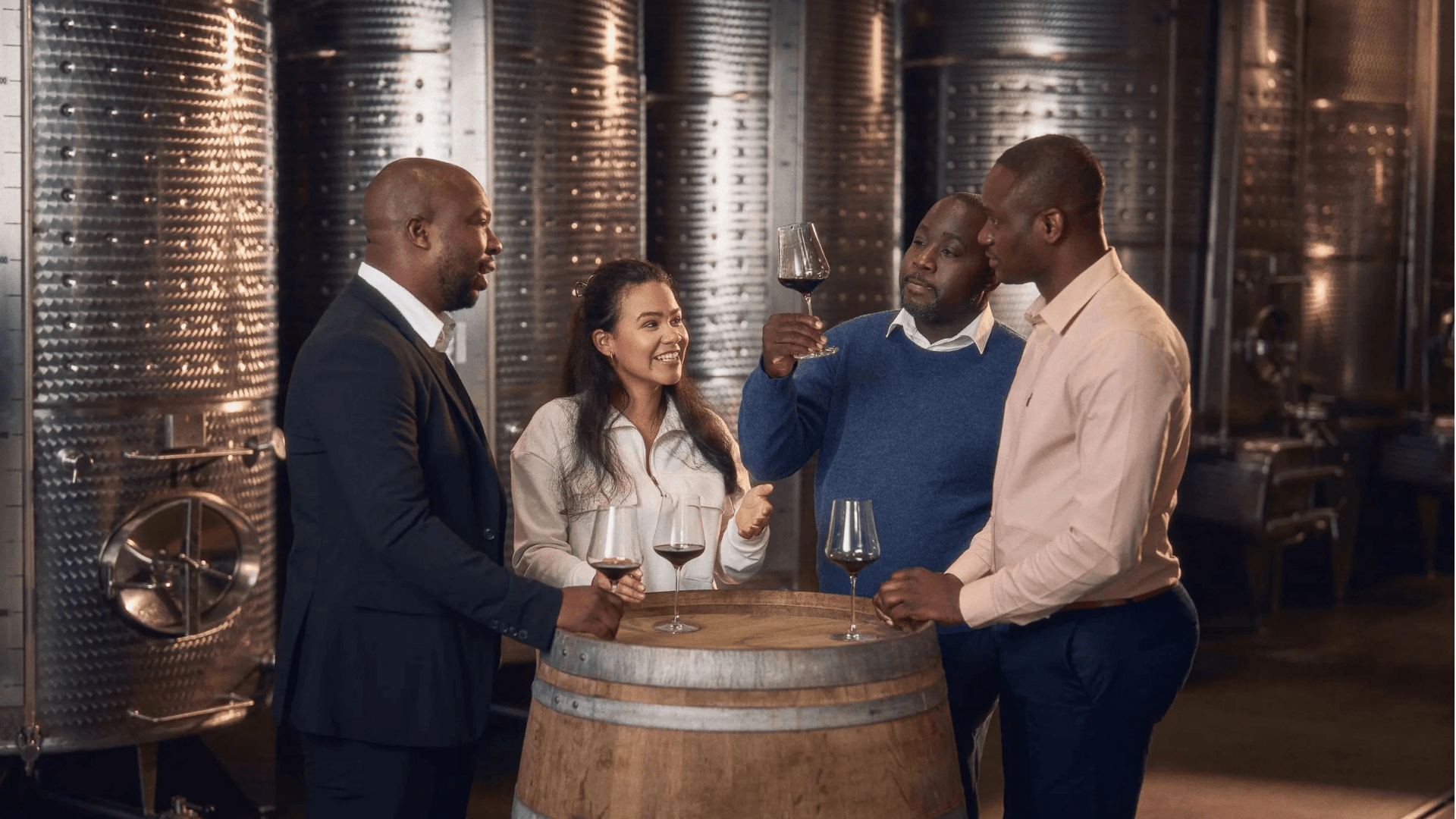
Women’s Month is great because we get to highlight incredible winemakers, who also happen to be women. I sat down with seven of them – I’d have happily spoken to fifteen – to hear their stories: where they see the industry in ten years, which winemakers they’re rooting for, and the dish they’d pair with a wine from their own portfolio.
I cried, I laughed, I had very important conversations with all of them and, best of all, I came away realising just how much potential is still untapped. That’s crazy exciting.
I spoke to Marelise Niemann, Charla Bosman (Haasbroek), Mahalia Khotjane, Berene Sauls, Kiara Scott Farmer, Elizma Visser, and Melissa Nelsen – winemakers at different stages of their journeys, from very different backgrounds. What emerged was a shared conviction: South African wine is at a turning point, and women in leadership are at the forefront of it.
Marelise Niemann: The relationship economy
Winemaker, Momento Wines · Known as “The Grenache Queen”
Marelise’s journey started almost 20 years ago. She has specialised in Grenache and is commonly known as “The Grenache Queen”.
“Winemaking itself is for everybody,” she says. Marelise believes relationship-building is directly tied to who drinks your wine – and that the conversation about women in wine should also focus on who’s in the buying rooms, the import offices, and the restaurant ownership structures, not just who’s in the cellar. I think it leaves us with an interesting thought: there’s still plenty of opportunities for women to grow into positions of power across the business side of wine, not only the winemaking side.
The woman she’s watching most closely right now is Anmar Van Niekerk, Head Winemaker at Gabriëlskloof – rock solid in the cellar, hands-on, building her own brand, and in Marelise’s words, a “superwoman who doesn’t get nearly enough attention”.
Favourite pairing: Paardeberg Grenache + tuna carpaccio with olive oil and Maldon salt
Charla Haasbroek: Making wine on her own terms
Winemaker, Charla Haasbroek Wines
Charla’s winemaking journey reads like a masterclass in mentorship. Abrie Beeslaar at Kanonkop gave her the work ethic. Reenen Borman at Boschkloof introduced her to fine wines she’d never have accessed so young. Tim Atkin gave her the Young Winemaker of the Year award and has followed her career ever since. David Trafford and Simon at Sijnn brought farming techniques and international connections.
Now, building her own brand means she can be there for her kids’ hockey games, cook dinner when she wants to, and build something sustainable in the process.
Her vision for the industry is refreshingly simple: “more people drinking wine” by getting the right bottle in front of the right person. She hopes her kids might one day walk into the winery and call it theirs.
Favourite pairing: Sémillon / white blend + melanzane (egg plant) with tomato and cream
Mahalia Khotjane: Iron sharpens iron
Winemaker, Three Quarters
For Mahalia, the Cape Winemakers Guild was her gateway into the industry. She knew she wanted her own brand, but the network was the key – and the mentorship outlasted the three-year programme. The peers she found there are still sharpening each other.
Her most personal wine is the Leroel Rosé – increasingly difficult to make, she says, because it carries the weight of her parental aspirations. “It’s a love letter to my kids. Balanced, expressive, great company.” A wine that has to be all the things she wishes for her children.
Her vision for the next decade is anchored in a passage from The Black Sommelier that resonated with her so strongly, she sent to be included here: “an industry where farm workers who tend the vines can afford the wine those vines produce. Where cellar hands have a career pathway that doesn’t end at the cellar door. Where tasting rooms are as welcoming to a young Black woman from Soweto as they are to a wine buyer from London.”
The winemakers she’s watching? Shanice from Brookdale and Mosima Mabelebele from Le Grande Domaine – young, dynamic, and a mirror of her own hopes for the next generation.
Favourite pairing: Red blend + Mexican pulled pork tacos with jalapeño
Berene Sauls: Pioneering new ground
Winemaker, Tesselaarsdal
Berene’s story begins in Tesselaarsdal – a small, poor town of roughly 2,000 people in the Overberg – and it may end there too, in the best possible way.
Tesselaarsdal is provisionally approved to be demarcated as a wine appellation – how freaking cool is that! An area known for wheat and sheep farming will one day be known for great Pinot Noir and Chardonnay. The soils are 100% clay, ideal for Pinot Noir. Berene planted bush vines (yes, bush vine Pinot Noir!); something I’d never heard of before. The first bottled wine from her own property will be released in 2031, with fewer than 1,000 bottles and I am very excited to taste it.
Her long-term vision isn’t just about wine. It’s about what wine can do for a town. “Just because you come from a poor background doesn’t mean your chances are zero to zero.” She wants career days at public schools. She wants the right money flowing back into Tesselaarsdal. She calls it a 50-to-100-year plan.
The women she’s rooting for span generations: Kiara Scott (“a force to be reckoned with, and genuinely kind”), and her own mother – the first woman of colour in Tesselaarsdal to hold a driver’s licence, who built her first house at 19.
Favourite pairing: Pinot Noir + lamb waterblommetjie bredie
Kiara Scott Farmer: Science, curiosity, and the long table
Cellarmaster, Hazendal
What drew Kiara into wine wasn’t romance or tradition. It was science – the sheer curiosity of how grapes become something so extraordinary. That intellectual energy still drives her.
She’s immersed in Stellenbosch now, and only recently has she fully appreciated just how exciting the region is. Internationally, she’s watching the Canary Islands and Greece – volcanic ash wines, ancient varieties, terroir that tells a completely different story.
Her vision for the industry in ten years is one shared by almost every woman in this series: second-generation people of colour in leading roles, not just cellar positions but cellar workers progressing to assistant winemakers, investment into new and poorer wine-growing areas, easier importation of grape varieties, and more government funding.
The women she admires most: Trizanne Barnard of Trizanne Signature Wines, Jolandie Fouché of Wolf & Woman Wines (who’s “making some banging wines”), and Terri-Anne at Longridge – an up-and-comer who’s loving biodynamics and impressing everyone she meets.
Favourite pairing: Carignan + full-house masala steak gatsby with egg and cheese from the Cosy Corner
Elizma Visser: The road less travelled
Winemaker, Olifantsberg
Elizma came to wine through science – but it’s the soil that has kept her engrossed on the job every day.
“My love for plants and soil drew me closer to the vines. Working with the vines gave me a way different outlook on wine, and I can’t see myself doing the one without the other.” It’s a sentiment that captures something essential about how winemaking has evolved: the cellar is only half the story. The other half is underground.
When she started, the industry was about absorbing as much knowledge as possible. Now, she says, it’s about something more nuanced: “Finding the balance between science, nature and business.” That triangulation – head, heart, and ledger – is the modern winemaker’s real challenge.
On the industry’s future, Elizma’s vision is grounded and generous: “A fair and sustainable industry that represents our commitment to the land and the people.” Not just great wine – but wine that sustains the farms, the farmers, and the communities around them. And on solidarity among women: “If we can continue to support each other within the wine industry, male or female, we are so much stronger because of it.”
Favourite pairing: Grenache Blanc + Thai green curry with lime, fish sauce, and coconut milk
Melissa Nelsen: Chasing bubbles
Winemaker, Genevieve
Melissa Nelsen’s entry into wine was almost accidental – a tasting room job in Bot River that turned into something she couldn’t shake. “People would travel from all over the world just to taste a wine, and I was blown away by that.” That wonder never left her. It just found a more specific home: bubbles.
Her turning point came at a tasting in Cape Town, where she met the brand ambassador for Salon Champagne. “It was my first step toward a deeper understanding of how terroir and individual winemaking styles create a unique signature.” That trip became the blueprint for Genevieve Cap Classique.
Bot River is her terroir of choice – and she’s not done with it yet. “We still have so much potential to unlock.” After buying grapes from the area since 2008, she finally purchased her own farm in 2017 and has begun planting. The excitement in her words is palpable: new varieties, new styles, the same consistently high-quality fruit she’s always loved.
The woman she’s watching is Rosa Kruger – her passion for viticulture, the Old Vine Project, and soil preservation aligns closely with Melissa’s own values. “Her work continues to inspire me and reminds me how important it is to care for the land for future generations.”
Her industry vision is pointed and specific: South African Cap Classique sold internationally at the prices it truly deserves. “South African wines are world-class, and I believe they have earned the right to command higher prices.” The gap is closing, she says – but not fast enough.
Favourite pairing: Rosé Cap Classique + Neapolitan-style pizza with anchovies
Next time you’re at a restaurant, ask for these wines by name. Ask for the story behind them. Because behind every bottle is a winemaker who built something – and a table she’s pulling others toward.
Ever wanted a private tasting in your home?
We offer bespoke tastings in your home – almost anywhere in South Africa.
About Lauren Segers-Jewell
I believe people, wine, and food are among life’s greatest pleasures, and creating spaces to taste, learn, and connect is at the heart of what I do. I’m a wine writer, judge, and businesswoman invested in the South African wine industry, heading up local sales at Brice & Burnett. I also founded the Kak Fancy Supper Club and a tasting group exposing the next generation to global benchmarks and new perspectives. Through my work, I aim to shift our relationship with alcohol away from excess and towards appreciation, context, and connection – offering a look into the wine world through real experiences around the table.
Connect with Lauren
Email | Instagram | Kak Fancy Supper Club

0 Comments